Cummins RS20A: motor starting is a separate load question
Robert Hamilton · BeeWarm
Separate RS20A running output, motor-starting conditions and the exact equipment package before a Lower Mainland backup-power assessment.
AI-assisted editorial research for Robert’s BeeWarm series. Manufacturer sheet revision October 2019 is identified explicitly. No personal test, installation, endorsement or current stock is claimed.
Start with the exact RS20A configuration
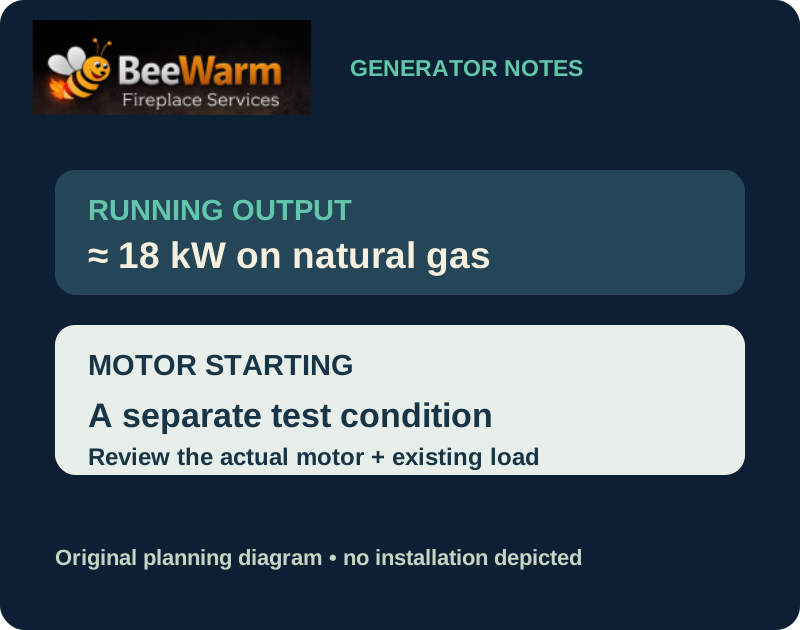
The Cummins RS20A lead in this series points to the manufacturer’s Quiet Connect sheet NAS-6254-EN, revision October 2019, still available from Cummins when checked on November 2, 2026. Its RS20A row identifies C20N6H and lists 75 amps on natural gas and 83.3 amps on propane vapour at 120/240 volts, 60 Hz. At 240 volts those figures correspond to about 18 kW and 20 kW respectively. Keep the fuel and configuration with the number. The age of the sheet is explicit: obtain current exact-unit documentation and Canadian supply confirmation before choosing equipment.

A motor-starting figure answers a different question
The same sheet publishes 40 kVA motor-starting capability at a 30% voltage dip for RS20A/AC. That is a stated test condition, not another 40 kW of continuous output and not a promise about a particular pump or compressor. Ask the electrical designer to review the actual motor, starting method and the equipment already operating when that motor starts. The useful question is whether the proposed system will deliver the household’s intended outage experience under the relevant conditions, not whether a large starting number appears in the brochure.
Write down what may restart together
A home can have several devices that respond after an interruption: a drainage pump, refrigerator or heating equipment, for example. Those are hypothetical planning categories, not a claim that the RS20A can run any selected combination. Give the designer accessible equipment records and explain which functions are priorities. Record which items may wait and which require further investigation. A short sequence such as “heating calls while the pump is already running” can be a useful question for assessment; it does not establish the measured load or select a design.

Decide what interruption the household can accept
Discuss which activities you expect to continue and which you are prepared to defer. Include essential property functions and the practical effects of losing discretionary appliances. Then ask the designer to explain the operating plan in ordinary terms: what is backed up, what is excluded and what may be delayed. This makes proposals easier to compare than asking whether a generator suits a house of a particular floor area. If a need is critical, discuss a separate contingency plan rather than treating this educational comparison as a reliability assurance.
Load management needs an identified package
The brochure describes load-management capability, but a useful quotation must identify the actual controls and accessories being supplied and the loads they will govern. Ask what happens when demand rises, which loads recover first and what the owner should expect. Do not assume an existing appliance will be managed simply because the generator family supports that function. Have the supplier and electrical professional confirm the complete arrangement and the applicable Canadian configuration. This guide does not select a transfer switch, assign circuits or provide connection instructions.

Keep RS20A, RS20AC and cold-weather variants distinct
The manufacturer sheet separates RS20A from the RS20AC package and lists additional cold-weather variants. Ask the supplier to state the complete order designation and exactly what the package includes. An offer for a similarly named unit should not inherit accessories or approvals from another row. Local conditions and the proposed location belong in the professional assessment. This article does not turn a catalogue package description into confirmation that a particular transfer arrangement is accepted for your property, or that any model is currently available from BeeWarm.
Coordinate the gas and electrical assessments
Robert’s gas-side review and the electrical load plan need the same proposed equipment identity. Provide the existing gas-appliance list and available site records, and ask who will assess combined supply requirements. The electrical output rating alone does not describe whether the meter and piping are suitable. BC Hydro’s backup-power guidance calls for appropriate transfer equipment, an electrical permit and inspection for connections to building wiring. Have the responsible professionals confirm the project-specific requirements, placement and handover. Do not adjust gas equipment, open electrical covers or attempt connection work from this article.
Ask for a handover that explains the operating plan
Before accepting a proposal, ask what records and owner instructions will be provided, who handles commissioning and whom to contact about maintenance or a fault. The final record should identify the actual backed-up functions and any operating limits the design depends on. Keep the accepted equipment list with the project documents so a later change, such as a new pump or heat pump, can be reviewed against the existing plan. A model comparison is a starting point for that conversation, not a completed design.
Bring Robert a focused Lower Mainland brief
Send the property type, outage priorities, actual motor and appliance records, existing gas loads and the full equipment quotation. Robert Hamilton at BeeWarm is the named contact for this series and for discussing the gas-side scope and coordination; confirm availability and work directly. General NaturalGasGenerators.ca enquiries retain their separate site contact. This is manufacturer-based editorial research, not a customer project report, equipment offer, personal test or claim of a Cummins dealer relationship.
Sources and exact-model check
- Cummins: Quiet Connect NAS-6254-EN (October 2019), model table and starting condition ↗
- Cummins: RS20A current product and specification directory ↗
- BC Hydro: backup-power connection safety ↗
Specifications can change. Recheck the exact model, fuel, voltage and current supplier documentation before ordering.
Continue your plan
KOHLER 14RCA: a 12 kW natural-gas plan with clear priorities · Generac 7226: plan essential circuits around 17 kW on natural gas
Load-sizing priorities · Installation planning · Lower Mainland city guides · All guides