Generac 7226: plan essential circuits around 17 kW on natural gas
Robert Hamilton · BeeWarm
Robert’s BeeWarm guide to the Generac 7226: separate the natural-gas rating, essential circuits, starting demand and the exact Canadian equipment package.
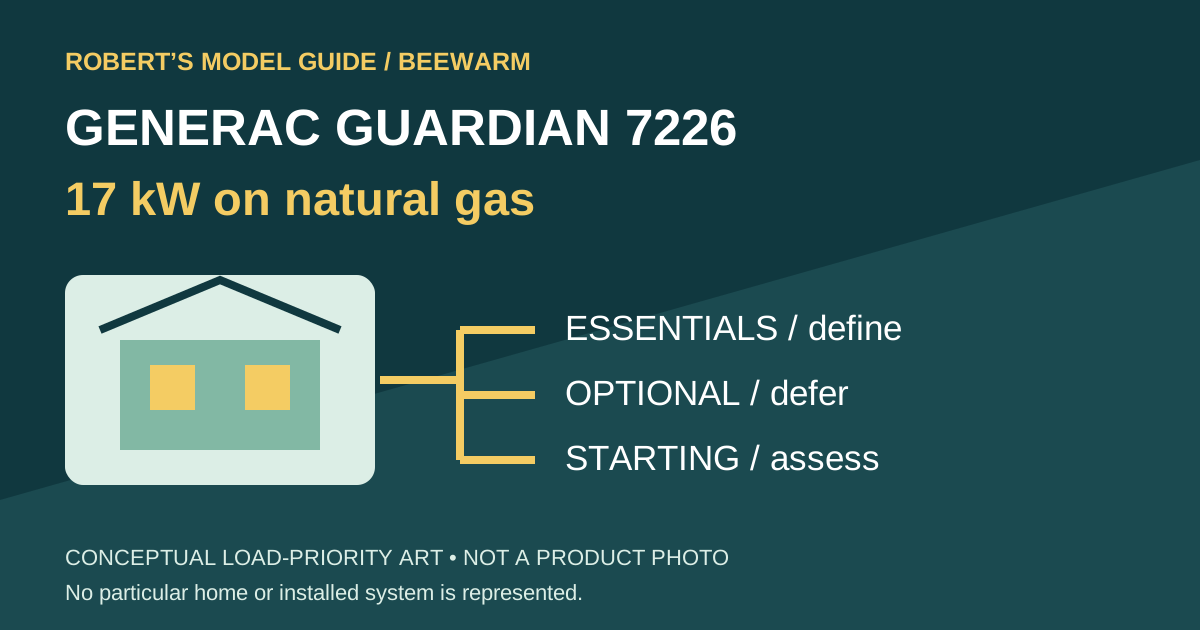
Prepared editorially for Robert’s BeeWarm series using manufacturer documentation. No personal product test, customer installation or manufacturer affiliation is claimed.
What does the 7226 rating actually mean?
Generac’s current 7226 product page identifies base model G007226 and lists maximum continuous output of 17,000 watts on natural gas and 18,000 watts on liquid propane. For a property supplied by utility natural gas, use the 17 kW figure in the initial brief. The manufacturer’s Guardian brochure places 7226 in the generator-only column for the 18/17 kW range and describes a 120/240 V single-phase configuration. The linked specification sheet identifies a 60 Hz standby unit. Confirm the full model suffix and Canadian configuration with the supplier; this is not a prime-power recommendation.

Choose the outage experience before choosing the circuit list
Start with a sentence describing the result you want: for example, “We want selected household essentials operating while we leave high-demand discretionary appliances off.” That is a hypothetical planning goal, not an assessed design. It is more useful than asking whether a generator can power a house of a particular floor area. Two similarly sized homes can have different heating, pumping, cooking and charging equipment. Tell Robert what an acceptable outage day looks like, who uses the property and which interruptions would create the biggest practical difficulty.
Make three lists:must run,can wait,needs investigation
A hypothetical must-run list might name a refrigerator, selected lights, communications equipment and the electrical components of a gas furnace. A can-wait list might include an EV charger, clothes dryer or hot tub. A third list should capture equipment whose actual requirements you do not know, such as a drainage pump or heat-pump compressor. These examples do not establish that the 7226 can start or run them together. Record the actual equipment and ask the electrical contractor to turn those priorities into a checked load plan. A list of room names alone does not provide that evidence.

A circuit label does not describe every appliance on it
An essential-circuit proposal needs to explain what each selected circuit serves. “Kitchen” may cover different appliances at different properties, and “heating” can describe a gas furnace’s electrical components or a much larger electric heating demand. Give the designer accessible appliance-label photographs and any existing circuit schedule, and identify additions made since that schedule was prepared. Do not remove electrical covers or investigate wiring yourself. Ask for a clear written explanation of the intended backed-up loads, the excluded loads and any operating restrictions that the proposed arrangement depends on.
Check starting events as well as normal operation
Motors and compressors can impose a different demand while starting than while running. A plan based only on adding normal running watts can miss that distinction. Explain what may restart after an outage and whether several devices could call for power at the same time. An automatic system still needs a reviewed sequence and appropriate equipment. This article has not tested a 7226, measured starting current or assessed a customer installation. A manufacturer’s broad appliance example is not a guarantee about the particular pump, compressor or HVAC equipment at your home.

Separate the generator from the transfer package
The brochure distinguishes generator-only model 7226 from model 7228 in its 200-amp service-rated load-shedding switch package column. More importantly for a Canadian enquiry, the linked manufacturer specification includes a certification caveat: its Canadian certification statement applies to unbundled units and limited-circuit-switch packages, while its Smart Switch packages are identified as certified in the USA only. Do not treat a similarly named online bundle as automatically appropriate for British Columbia. Ask the supplier and electrical contractor to confirm the exact generator, transfer equipment and applicable Canadian approvals before ordering.
Ask what load management would change
If the proposed system includes load management, ask which appliances it controls, how priorities are set and what the homeowner should expect when demand changes. “Managed loads” should lead to an understandable operating plan rather than an assumption that every appliance remains available simultaneously. The arrangement may require different equipment from a selected-essential-circuit proposal. This guide does not select a switch, assign circuit ratings or provide connection instructions. The useful buyer decision is whether the proposed outage experience matches the household priorities already documented.
Read the exact-model gas figures before assessing the supply
Generac’s linked Guardian specification sheet groups G007226-0 and G007228-0 in its 18 kW column. Page 4 lists natural-gas consumption of 169 ft³/h (4.79 m³/h) at half load and 247 ft³/h (6.99 m³/h) at full load. Its inlet-pressure note gives 3.5–7.0 inches water column (0.87–1.74 kPa) for natural gas across the load range. For comparison only, that note gives a different LP range: 10–12 inches water column (2.49–2.99 kPa). These are manufacturer specification figures for professional assessment, not measurements at your property. The sheet also says fuel piping is to be sized for full load. The live product page repeats a fuel-consumption value; this guide uses the model-labelled PDF table rather than treating that web entry as a design basis.
Pressure and capacity are different questions
An existing gas connection does not establish adequate supply for a generator. Robert needs the exact model together with the other gas appliances, their demands and the property’s actual supply conditions. A pressure reading alone does not answer whether the meter, regulator and piping can support the proposed combined demand. Have the responsible gas professional confirm the applicable model/manual revision, required inlet conditions and actual supply assessment. Share accessible meter and appliance-label photographs and existing records. Do not adjust a regulator, open gas fittings, test pressure or select a pipe size from this article.
Include placement,permits and a maintenance handover
The generator is one part of a building project. BC Hydro’s backup-power guidance calls for suitable transfer equipment, an electrical permit and inspection when connecting a generator to building wiring. Have the responsible professionals confirm the actual approvals, exhaust and opening relationships, service access and location for the property. Ask who is responsible for each scope before work starts. The final handover should explain operating expectations, maintenance responsibilities and whom to contact for support. This is a project checklist, not a claim that BeeWarm holds a manufacturer authorization or that a particular site has been approved.
Send Robert a focused Lower Mainland enquiry
Tell Robert the property location and type, whether natural gas is already available, your must-run and can-wait priorities, and whether the exact 7226 model has been quoted or purchased. Include the equipment package details rather than only “18 kW Generac.” Robert Hamilton at BeeWarm is the Lower Mainland installation-enquiry contact for discussing gas-side scope and coordination with the other project professionals. Call or text 604-765-8424, email bee@beewarm.ca or use the BeeWarm contact page. Confirm actual work, availability and pricing directly. No equipment sale, installation booking or manufacturer relationship is implied by this research-based guide.
Sources and exact-model check
- Generac:7226 product page and fuel-specific output ↗
- Generac:linked10/14/18kW specification and Canadian package caveat ↗
- Generac:Guardian brochure,model and package comparison ↗
- BC Hydro:backup-power connection safety ↗
- BeeWarm:Robert’s project enquiries ↗
Specifications can change. Recheck the exact model, fuel, voltage and current supplier documentation before ordering.
Continue your plan
Load-sizing priorities · Installation planning · Lower Mainland city guides · All guides