KOHLER 14RCA: a 12 kW natural-gas plan with clear priorities
Robert Hamilton · BeeWarm
Robert’s BeeWarm guide to the KOHLER 14RCA: use its exact natural-gas rating, decide what can wait, and request a professionally checked operating plan.
AI-assisted editorial guide prepared for Robert’s BeeWarm series and checked against the linked manufacturer documentation. No personal product test, customer installation or manufacturer affiliation is claimed.
Read the fuel column before the model number
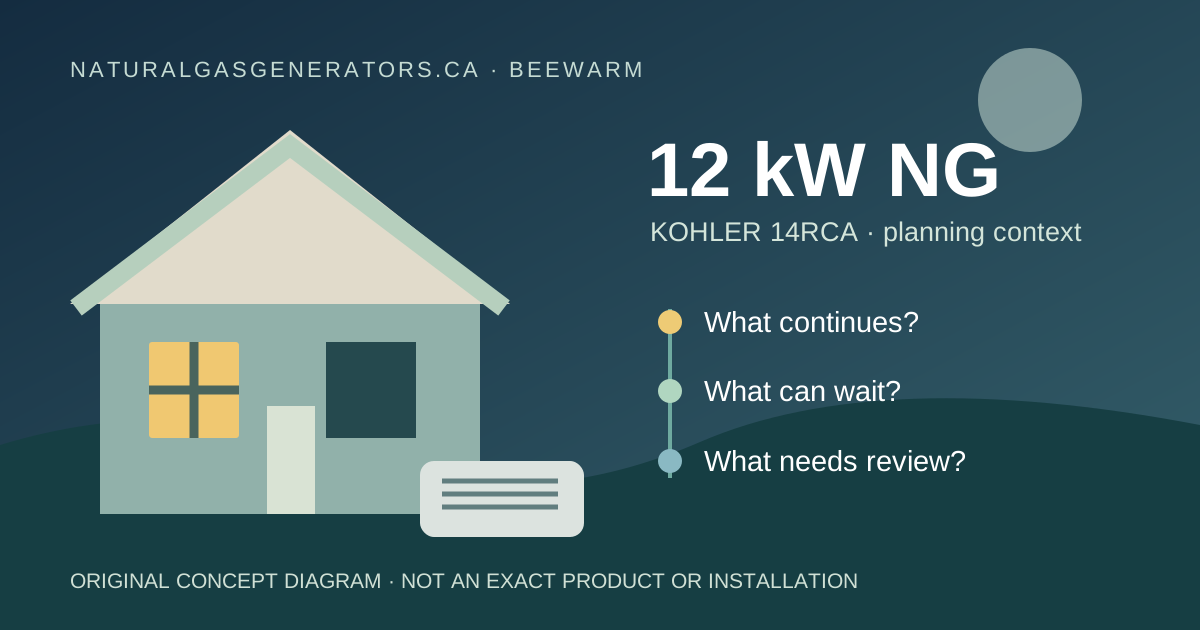
The KOHLER 14RCA name does not mean 14 kW on utility natural gas. The current manufacturer product page lists 12 kW on natural gas and 14 kW on propane. In specification G4-270, revision 4/26j, the 14RCA/14RCAL 2F5 row identifies the 120/240 V, single-phase, 60 Hz configuration. This guide concerns that natural-gas standby planning case. The sheet also contains other configurations; a similar model name is not enough to establish the equipment being quoted. Ask for the full model and specification before comparing proposals.

Write down what an acceptable outage day looks like
A useful smaller-generator enquiry starts with trade-offs. For a hypothetical household, that might mean keeping selected refrigeration, lighting and communications available while leaving laundry, vehicle charging and discretionary electric heating out of the outage routine. These are examples of priorities, not a claim that this model supports a particular combination. Name the actual equipment, who relies on it and what interruption is tolerable. Ordinary household backup planning must remain separate from any medical or regulated life-safety requirement, which needs its own appropriate assessment.
Describe a waiting rule, not just a wish list
A homeowner may be willing to postpone one activity but still expect another appliance to be available whenever needed. Record that distinction. “Laundry can wait until utility power returns” is clearer than “we will probably use less electricity.” Ask the designer which expectations the proposed arrangement can support and which depend on controls, exclusions or a different generator. If household routines change, the written plan should be reviewed. Do not rely on everyone remembering an informal promise as a substitute for an appropriately designed electrical arrangement.

Ask how the plan handles a restart
A list of running watts does not describe every starting event. Pumps, compressors and other motor-driven equipment may have different starting demands, and several devices may call for power after an outage. Have the electrical professional evaluate the actual equipment and the intended sequence. Ask what the user will notice if a managed load is deferred or unavailable. This guide does not assign circuits, specify a controller or provide connection instructions. A manufacturer’s appliance example cannot establish how an unassessed home will operate.
Keep the standby rating in its stated context
The manufacturer identifies these as standby ratings and specifies variable-load conditions, including an 80 percent average load factor and no overload capability specified. The 12 kW natural-gas figure is not an unconditional promise of continuous household capacity. The responsible designer should apply the current specification, site conditions and actual equipment requirements. This article does not calculate an allowable customer load or translate that average-load note into a homeowner operating limit. Its purpose is to make the proposal’s assumptions visible before equipment is purchased.

Confirm the package and gas-side scope together
The current product page distinguishes 14RCA from the transfer-switch package identified as 14RCAL. Confirm the exact generator, transfer equipment, any proposed load-management components and applicable Canadian suitability with the supplier and electrical contractor. Existing natural-gas service alone does not prove adequate fuel supply. Give Robert the selected specification and other connected gas-appliance details so the gas-side scope can be assessed. Placement, exhaust relationships, access and required approvals belong in the project review; none is established by choosing a model online.
Request an operating handover you can understand
Before accepting a proposal, ask for a plain-language account of what remains available, what is excluded, what may be deferred and who maintains the system. Have the responsible professionals explain the intended operation and support arrangements. Do not open electrical equipment, adjust gas components or improvise a transfer arrangement using this article. A good brief also records who coordinates the electrical, gas and equipment scopes. The smaller-model decision is useful only when the resulting outage experience matches the household’s assessed needs.
Bring the priorities to Robert
For a Lower Mainland enquiry, send the property location and type, the complete 14RCA model information, whether natural gas is already present and the activities you are prepared to postpone. Robert Hamilton at BeeWarm is the contact for discussing gas-side assessment and coordination; confirm the work he can support, availability and pricing directly. Call or text 604-765-8424, email bee@beewarm.ca or use the BeeWarm contact page. Read BeeWarm’s existing natural-gas generator planning resource for the wider project brief. No equipment stock, booking, manufacturer authorization or installed result is implied.
Sources and exact-model check
- KOHLER Home Energy by Rehlko: 14RCA fuel-specific product information ↗
- Rehlko: G4-270 14RCA specification, revision 4/26j ↗
- BeeWarm: existing natural-gas generator project-planning resource ↗
- BeeWarm: Robert’s installation enquiries ↗
Specifications can change. Recheck the exact model, fuel, voltage and current supplier documentation before ordering.
Continue your plan
Load-sizing priorities · Installation planning · Lower Mainland city guides · All guides